
Musing on the Muse: Legacy in the Age of Artist-as-Curator
Published in The Toe Rag, Summer 2024.

For several years now, Frieze London has dedicated a section of their fair to Focus, ‘a platform for emerging artists across generations, cultures and continents’ as they describe it. In 2023, Frieze launched Artist-to-Artist to inaugurate their twentieth anniversary. The initiative saw the likes of Olafur Eliasson, Tracey Emin and Wolfgang Tillmans each proposing an artist to showcase at the fair. Perhaps an attempt to cut out the middle man, the effect was to suggest a kind of direct lineage, proceeding from the ‘Modern Greats’ so-to-speak (Emin recently featured in a show at Hang Up Pictures titled Age of Icons) to an all-new cohort of emerging artists. It served, as all lists do, to make shape out of an amorphous mass. And despite all its potential limits, Artist-to-Artist was a success: work by Ayoung Kim, selected by Haegue Yang, entered the Tate’s collection as a result of the initiative.
It would be misleading to suggest that Frieze’s Artist-to-Artist directly inspired two group shows that opened in London this spring, as the Jerwood Survey at Southwark Park Galleries is already in its third iteration, and Material Girls and their Muses at Vitrine (which closed 18 May) is a reprise of a show by Marcelle Joseph a decade ago. Yet, the coincidence of all three shows almost back-to-back was too enticing to ignore.
The Jerwood Survey III – which opened 6 April and closes 23 June, when it will then tour to Cardiff, Sheffield, and Edinburgh – is a showcase of ten early-career artists each chosen by an established artist. It promises to be a non-institutional take on the current concerns and approaches within the UK contemporary arts scene. Free from the restrictions of the market, the survey enables artists to explore ideas that might be deeply pressing, yet not necessarily profitable.
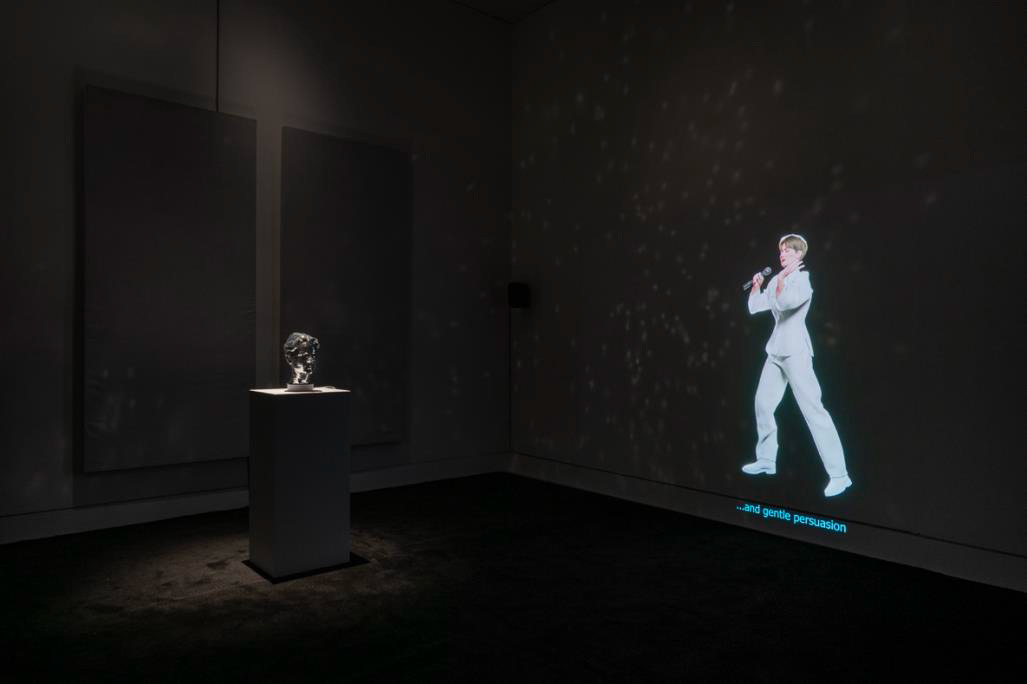
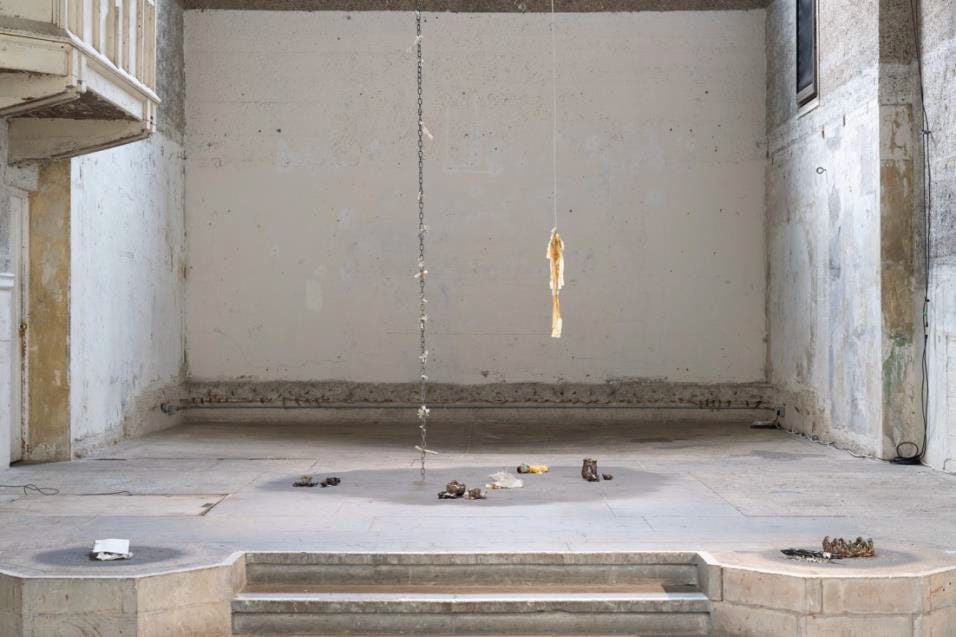
In spite of this, the Jerwood show is still fair-like in its composition: the works speak for themselves, but not to each other, nor to the artists who nominated them. For example, MV Brown’s System of Touch and Alliyah Enyo’s Aphotic Archaeology were both chosen by British-Finnish artist and composer Hanna Tuulikki, but that fact is relegated to the exhibition text. In the gallery itself, Enyo’s installation sits in the Dunston Gallery whilst audiences can hear Brown’s piece serenading from the Lake Gallery. The link might have emphasised the eerie, disturbing beauty to the pieces, both existing as almost-performances emerging out of the darkness. Indeed, the ‘Aphotic’ in Enyo’s title refers to the zone underwater with a complete absence of light. So despite the crucial differences in the works – Enyo’s profoundly austere installation against Brown’s camp spectacle – both feel simultaneously serious and absurd, possessing a strangeness only possible at the murky ocean floor. Given that Tuulikki’s own work draws on the ‘gestural mimesis of the more-than-human’ as a kind of ‘queer ritual’, we can even see our AI animated pop star, and the detritus of a deep-sea archaeological site, as animated by one and the same uncanny queer spark. Leaning into the link, it seems, would only have elevated the exhibition experience.
But this misunderstands what the Survey is looking to achieve. If Frieze gave us ‘artist-to-artist’ within the confines of an exclusive art fair, with all the marketable promise of ‘the next big thing’, Jerwood takes the approach and widens the parameters of who gets to engage with the ‘contemporary’ in the first place. This is especially in regards to audiences, as the exhibition tours the country, distancing it from the London-centric model.
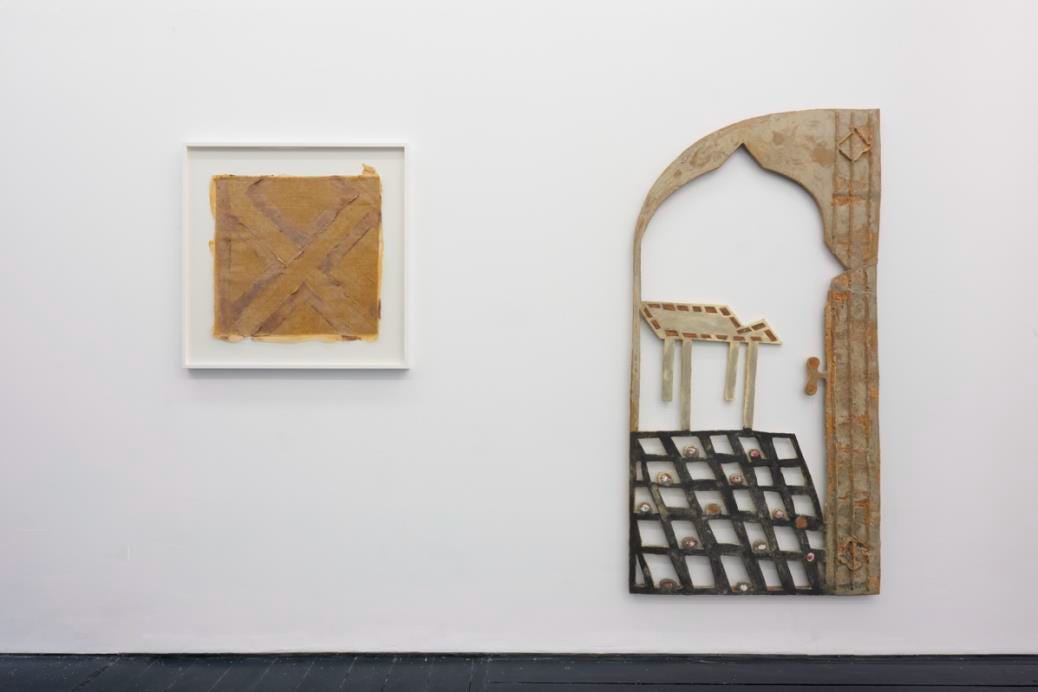
Vitrine took a different approach to Jerwood, and centres the relational aspect of ‘artist-to-artist’ by turning it completely on its head. Sacha Ingber and her muse Heidi Bucher for example, despite working decades apart, appear to be cut from the same off-white cloth. The play of negative space in Ingber’s Open, Aged, Staged (2016) calls out to the solid square of Bucher’s (Blätzli) Floorpiece from the Herrenzimmer (1978) to its left. Though one does not physically fit into the other, the pieces are brought together in their remembrance of former architectural wholes.
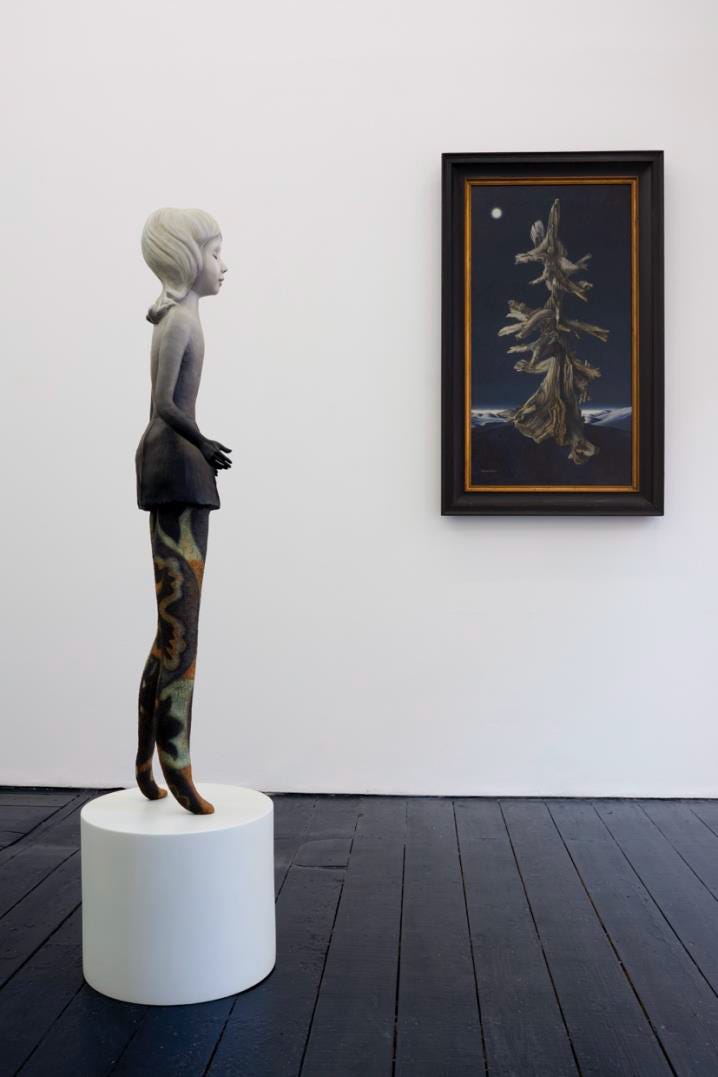
It is this spark between which characterises the exhibition on the whole. Visitors are given little context, works appearing without exhibition labels, so that the boundary between historical and contemporary is deliberately blurred. One appears to emerge out of the world of the other, like Cathie Pilkington’s Twinkle (2014) caught in the twilight daze of Marion Adnams Mount, Mount, My Soul (1967). Pilkington’s sculpture is painted in oils, giving the bronze a blue-grey matte finish. Impossibly, this ‘material girl’ appears to be made out of the wooden root of her muse. Her eyes are closed because she chooses to forgo sight: she has her muse as guide. Her world is the untouchable domain of spirits and muses: one which is all around us if we would only listen.
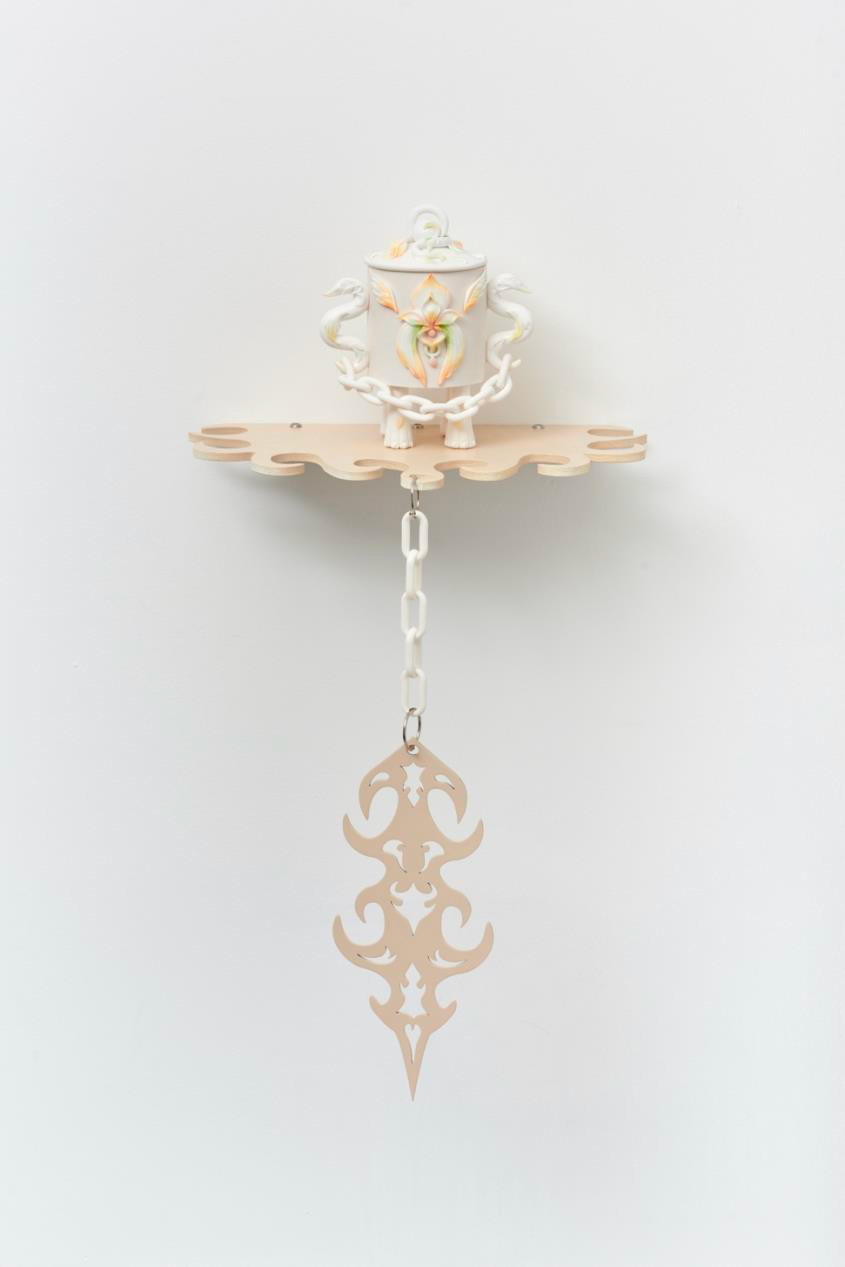
Except Vitrine does make us listen. Hannah Lim’s muse, Mariko Mori, sings out of Vitrine’s basement, and her siren song Miko No Inori (1996) sets the oneiric tone for the entire exhibition experience. If the visitor cannot resist the pull downstairs, they are met with an Orientalist fantasy dreamworld. Snuff boxes, typically tiny in size, are blown up to the stature of ornament, and the bright colours and floral patterns nod towards a long tradition of Chinoiserie. The works together articulate a story of colonial travel from West to East and back to West, and recast Orientalist reverie as a source of active feminine aesthetics. The muse, or in this case, the music, sings powerfully out of a dream, arrests the viewer and insists: I am here to stay.
What Mori’s and MV Brown’s films share is their mesmeric ability to hold the audience. They capture, in the dynamic interplay of two artists, an almost magical resonant frequency which compels us to stay put, and continue to listen. They reveal that fundamentally, when ‘artist-to-artist’ is done right, the powerful spark of the inbetween produces something greater than the sum of its parts.
Legacy is the wrong word: in many ways the artists at Vitrine imagine worlds outside of the patriarchal model of lineage. That being said, ‘Material Girls and their Muses’ establishes precedent for work that might have once been written off as a ‘flash in the pan’, ‘right place right time’, or simply luck. And when precedent is established, futures become possible, and all beyond the masculinist horizon. When the artist is curator, or when the contemporary curates the past, the present builds out into its history, and for a moment breaks out of the trappings of linearity. Artist-to-artist works. It works because the art world will project the models of lineage and legacy onto artists anyway. So drawing it out at a commercial fair will sell paintings; leaning into it will make the nebulous idea of the ‘contemporary’ more accessible; turning it on its head can create openings and imagine futures. It will be worth watching where artist-to-artist is taken next.